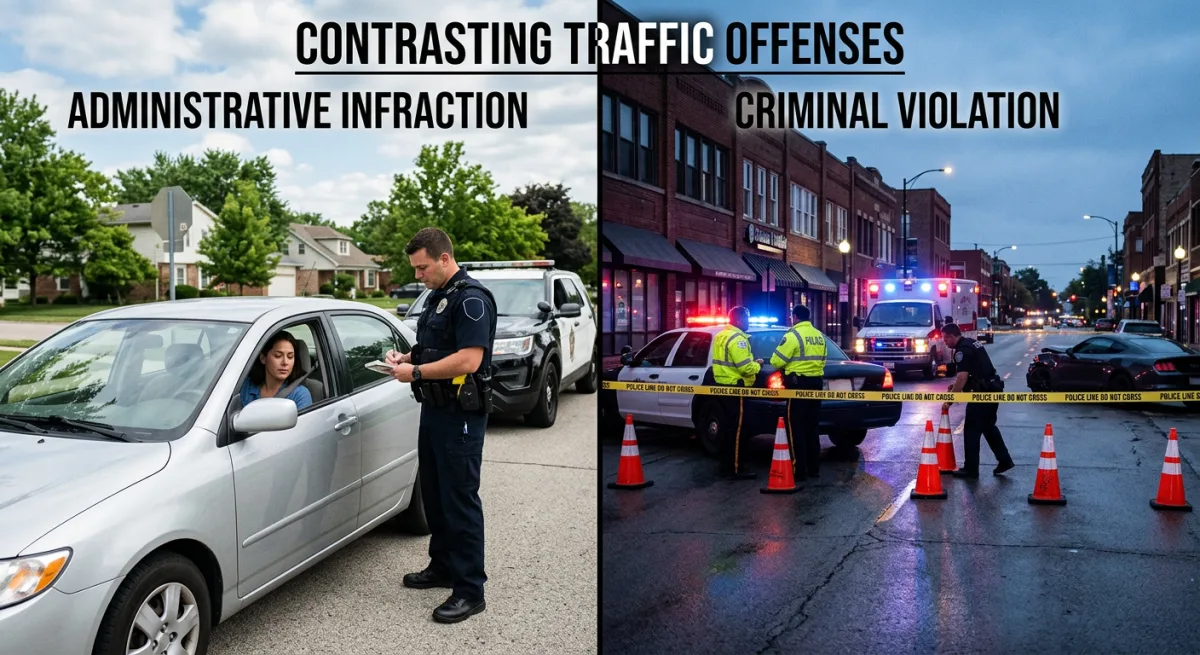
An Overview While the vast majority of traffic offenses are classified as administrative infractions—such as minor speeding, running a stop sign, or mechanical "fix-it" tickets—more severe violations cross the line into the criminal justice system as misdemeanors or felonies.
Unlike minor infractions, criminal traffic convictions result in significant fines, the immediate loss of driving privileges, potential incarceration, and a permanent criminal record. In most jurisdictions, a standard traffic violation escalates into a criminal charge if the driver's actions:
Cause actual harm: Result in physical injury to a person or the destruction of property.
Create an imminent threat: Exhibit a reckless disregard for public safety that creates a real, immediate threat of injury or property damage.
For example, running a red light is typically a civil infraction. However, it can escalate to a misdemeanor if it constitutes reckless driving, a felony if the driver crashes into another vehicle, and a severe felony (such as vehicular manslaughter) if an occupant of that vehicle dies.
Conversely, some traffic offenses are categorized as criminal violations from the outset, regardless of whether an accident occurs. These include driving with a revoked license, reckless driving, and leaving the scene of an accident (hit-and-run).
Constitutional Protections
Because traffic misdemeanors and felonies are true criminal charges, motorists accused of these offenses are entitled to the full suite of constitutional protections afforded to all criminal defendants. This includes the right to remain silent, the right to a trial by a jury of their peers, and the right to a court-appointed defense attorney if they cannot afford to hire private counsel.
Understanding Traffic Misdemeanors
The criminal justice system does not have the capacity or resources to handle every minor breach of the law with a full criminal trial. Consequently, state laws reserve the most severe penalties for felonies, utilizing the misdemeanor classification to penalize less egregious but still serious criminal actions.
By definition, misdemeanors are mid-level crimes that are generally punishable by monetary fines, probation, and a maximum jail sentence of less than one year.
Common Examples and Procedures
While precise legal classifications vary by state, common examples of misdemeanor traffic violations include:
Driving Under the Influence (DUI/DWI) of alcohol or drugs
Reckless driving
Failing to stop at the scene of an accident (minor hit-and-run)
Driving without a valid driver’s license or operating a vehicle without auto insurance
For many of these offenses, law enforcement will not simply hand you a ticket; they will take you into physical custody. Once booked into a local facility, you must follow the standard criminal procedure of posting a bail bond to secure your release prior to your scheduled arraignment and court dates.
Comparing Misdemeanor and Felony Consequences
Incarceration sentences for misdemeanor convictions are served in local or county jails rather than state penitentiaries, making them inherently less severe than felony sentences.
Furthermore, the collateral, long-term consequences of a misdemeanor conviction are significantly less restrictive. Unlike convicted felons, individuals with a misdemeanor traffic conviction on their record generally retain their core civil liberties, meaning they can still vote, serve on a jury, and maintain their professional and occupational licenses.